The day I learned of my naturalization was four days after it had actually happened. (I suspect sloth on the part of the Bureau of Legal Affairs guy in charge of my case. I could be wrong.) It was also two days before I was scheduled to leave on a trip to Indonesia to perform a mock FDA inspection of a medical device factory. Becoming a citizen was very good news. It also meant that I was a citizen without a passport. That meant I could not legally leave the country. I had to cancel the trip. Expensive airfares and hotel fees went to waste. I promised the client that I’d go as soon as possible, paying my own expenses to make up for the wasted ones.
I got my passport quickly. Two weeks, three max, after applying for it. I am impressed with the Tachikawa passport office at the very least. Great service and efficiency. With that, the trip happened a month later than planned, this past week.
As always, it was exhilarating to be in a new-to-me country. I had notions of exploration. Of humble learning. Of demonstrating impeccable cultural sensitivity and yet checking my privilege. All while deftly creating content to impress fellow denizens of the nation of Online that I was an unusual, special, superior tourist—nay, no tourist at all.
Reality (my client) gave me a non-optional comfortable stay in the hermetically sealed Japanese expat bubble of the Axia South Cikarang Hotel. Built by Toyota Tsusho and Takenaka Corporation to serve the many Japanese businesspeople who visit and reside to work in that part of Jakarta, it had two hotel towers, a residential condominium tower, sento-style baths, at least three Japanese restaurants, laundry service (heavenly creases in my running shorts), grounds for recreation and relaxation, and a Japanese grocery store selling everything from sashimi to Asahi Super Dry.
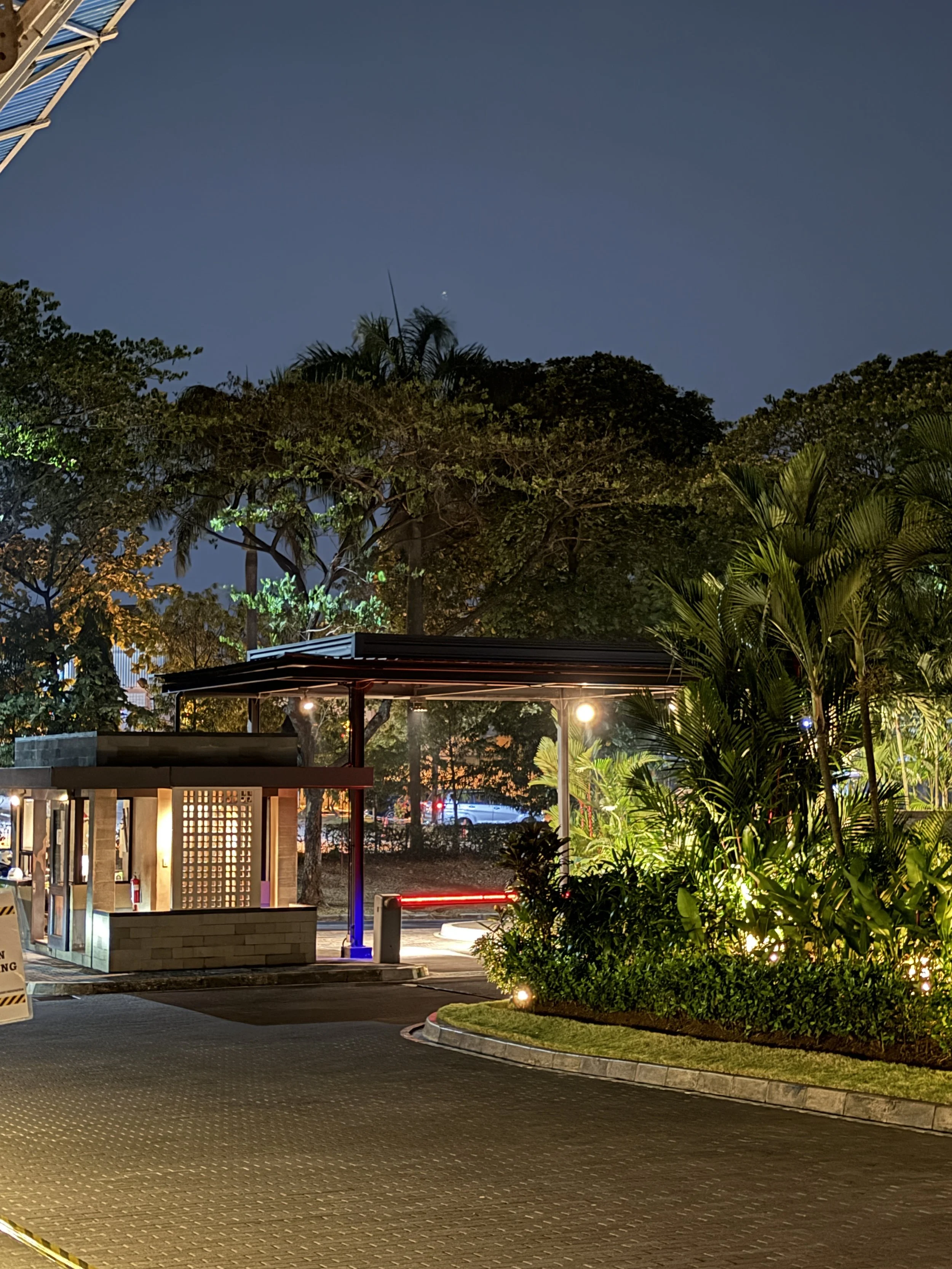
One of the hotel entrances, with LED-lit gate and multiple friendly security guards
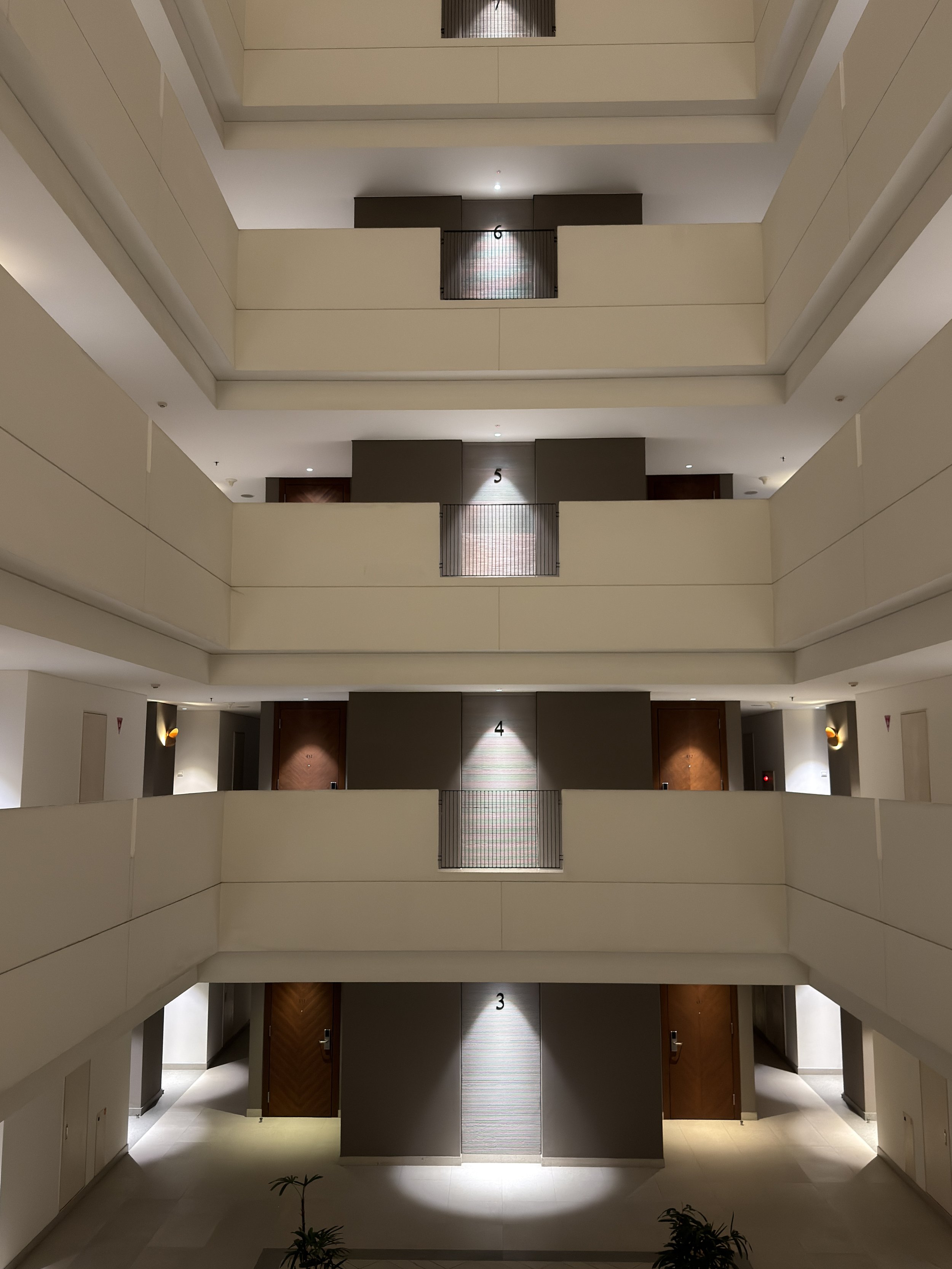
The Takenaka-Corporation quality (longtime TC fan here) inner courtyard of my hotel tower
A lot of people like me (doing okay enough financially to travel, mostly white, convinced that they are no mere tourist—”it’s this vulgar rabble on my same flight and in the same hotel and walking around the same places who are tourists, damn them”) seem to think it is a moral failing to visit a country and not partake of the authentic experiences of its general public (whatever that means). There is an ambiguous but nevertheless expected effort to do things/go places that can be reasonably portrayed as not tourist activities/places. In this sensibility, which I dare say is prevalent, tourists are expected to make all due efforts not to be tourists. It benefits no one involved except the ego of the non-tourist. It is somehow unseemly to acknowledge precisely what one is in a tourist situation—a tourist.
Endless questions and contradictions can be raised about this prevailing sensibility. For example, I could find a local restaurant where local people eat and congregate. Assuming that it is not feasible for me to become conversant in Bahasa Indonesia, that means my presence in the restaurant will require its operators to understand my English, or at the very least we will all have to speak into a phone to understand each other. All this might be fun for me and/or the operators, or it might be a burden. My presence might be a fun unusual event (if we take an “I’m special, of course they’ll be happy I’m there” perspective) or it might be an unpleasant unusual event, for any number of cultural, political, or other reasons. It could go either way. That’s life. It’s probably fine for me to go there and experience something. I’m just saying that it isn’t the inarguable virtue it is portrayed to be.
There used to be an izakaya right outside the north exit of Takao Station called Asakawa Shokudo. My father in-law and other residents spent a lot of time there with the lovely Hasegawa family serving them drinks and meals. Rather than there being one local watering hole that a person would haunt, there were five establishments between Takao Station and Mt. Takao along the Koshu Kaido. If one was drinking that night (most nights for a lot of men), it was understood that they would visit three or four, and maybe all, of these.
Asakawa Shokudo was a fairly run-down exterior and interior, priced for locals, okay quality, and populated with a lot of local ojisan of personalities ranging from great to terrible. My father in-law kindly invited me many times to sit and drink Cokes while he and the men talked about local things. Inevitably, with the rote subjects all picked over, I would receive questions. They were also rote. Sometimes I would get tired of them, but I also love attention, so it was usually fun. Everyone seemed to enjoy this interaction. Importantly, I was able to converse. Even so, I bet some of the dudes just wanted the usual people chewing on the usual rote subjects and arguments and general atmosphere that they had been coming for since decades ago.
Not long after I came to town, the Michelin Guide gave Mt. Takao a three-star rating as a destination. The spread of Google Maps and dearth of places to eat on this side of Takao Station led many tourists from both Japan and overseas through the dingy noren of Asakawa Shokudo. It must have been a business boost. The local ojisan contingent soon began to grumble. Often, one couldn’t get a seat to enjoy his daily shochu mizuwari and small dishes and rote conversations and debates.
The consensus soon formed among ojisan that Asakawa Shokudo was no longer a reliable spot along their Koshu Kaido pilgrimage route of hashigo drinking. They would still wander into the place, of course. I bet they learned the patterns of when tourists were not there. But it stopped being a mainstay like before. The place is gone now for unrelated reasons. But that’s the story arc that pops into my mind when I encounter or reflexively follow the sensibility that one must seek out local people’s experiences as tourists.
On the other hand, tourist spots in tourist places give a taste of the place being visited, maintaining basic shared expectations by proprietor and customer about the transaction. Pricing finds a balance somewhere between competition among fellow tourist spots and the virtuous flushing of money away from tourists into the place’s economy. I think an argument exists—and I’m not making it here in full because I don’t want to do that work—that using tourist-oriented establishments as a tourist is better than seeking out locally staffed, patronized, and priced places that are not expecting or actively seeking out tourists.
Behold above! These are the lengths to which I will go to explain my shameful stay in a bubble that was meticulously designed to accommodate me, a person from Japan who had business at one of the many factories that Japanese corporations operate near Jakarta.
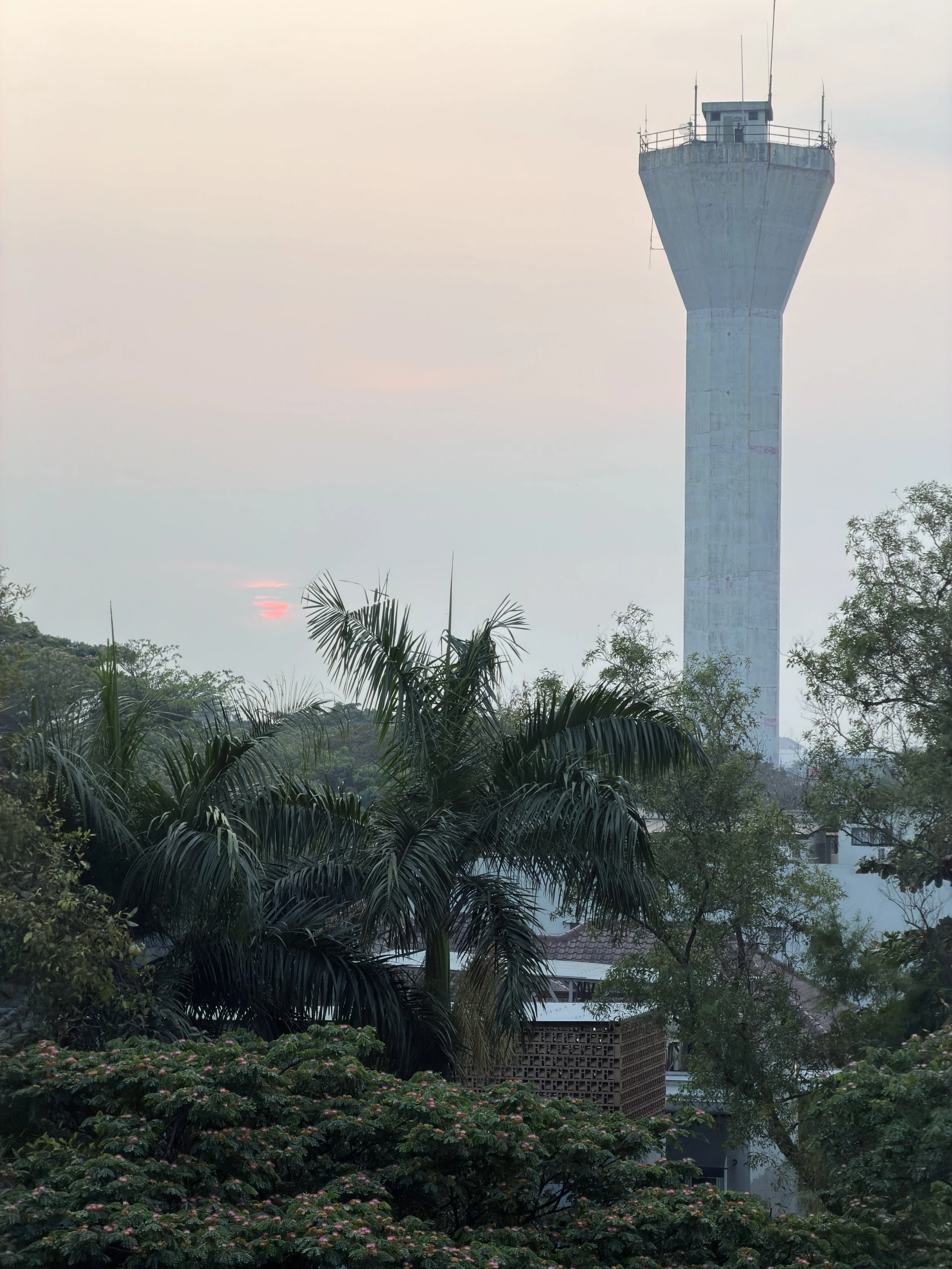
The sunrise view from my pristine hotel room
I got to interact with a few dozen warm and welcoming and highly skilled local people in the factory that I inspected. That was a great time. I ate a few lunches at the factory. They were delicious. We took breaks while workers went to rooms in the factory set aside for prayers. I got plenty of sights of the industrial part of Jakarta. I saw some very fancy residential developments. I saw some homes that were cobbled together from available materials.
A snippet of less fancy areas along the expressway and under the high-speed railway
I saw the swarms of motorbikes and trucks in the morning rush hour. I saw firsthand that doing my daily run out on the streets rather than on the treadmill inside the pristine gym would have been utter folly. I saw the sketchy air quality and resulting beautiful sunrises. The airport was nicer than most are in the United States. I got to feel that the equatorial weather is cooler (around 30 C) and about the same humidity as Tokyo in summer. Before the trip I needlessly worried that I should be buying copious amounts of linen to prepare.
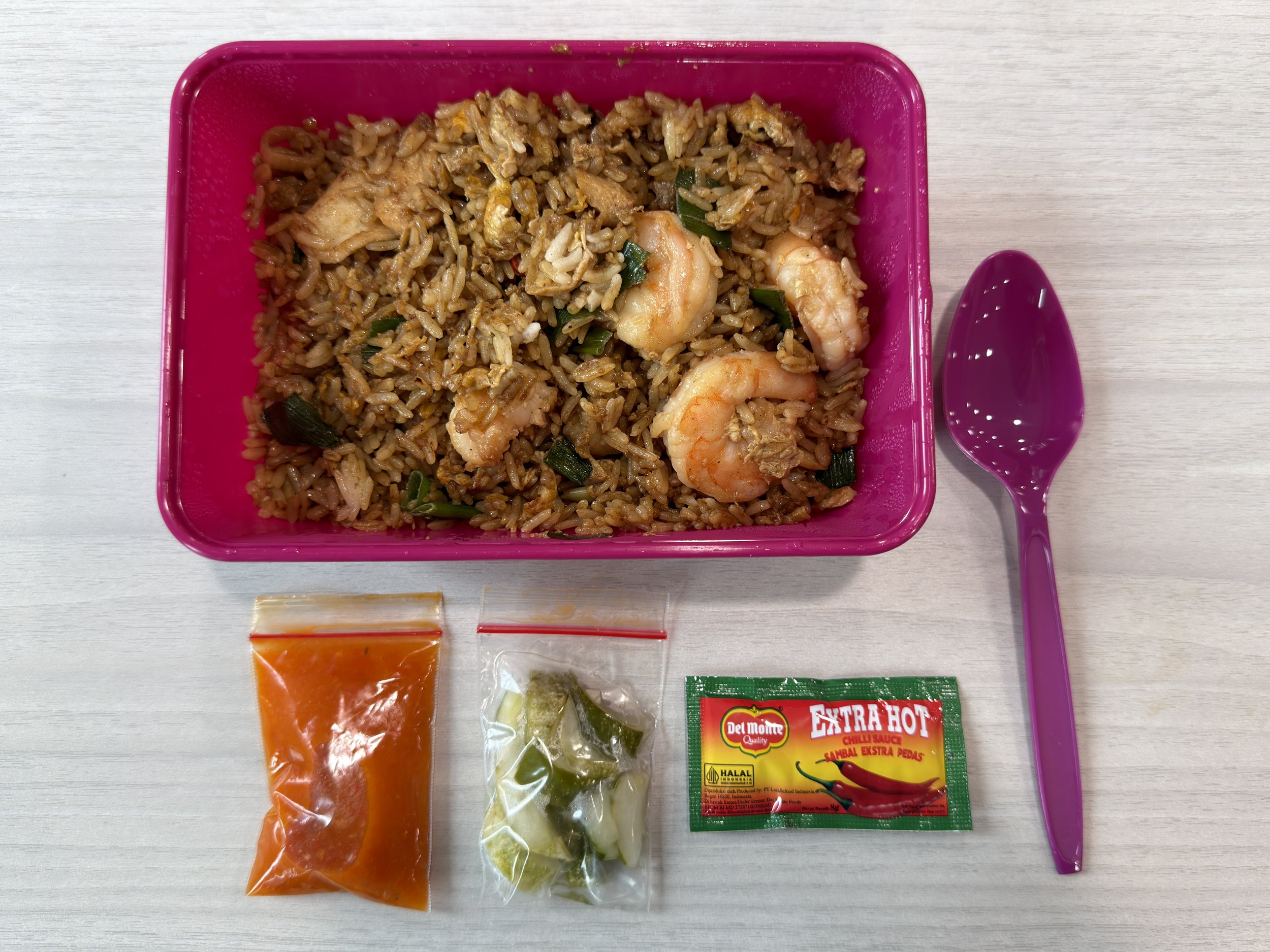
Nasi goreng udang, which slapped so very hard. A lifetime-memory meal.
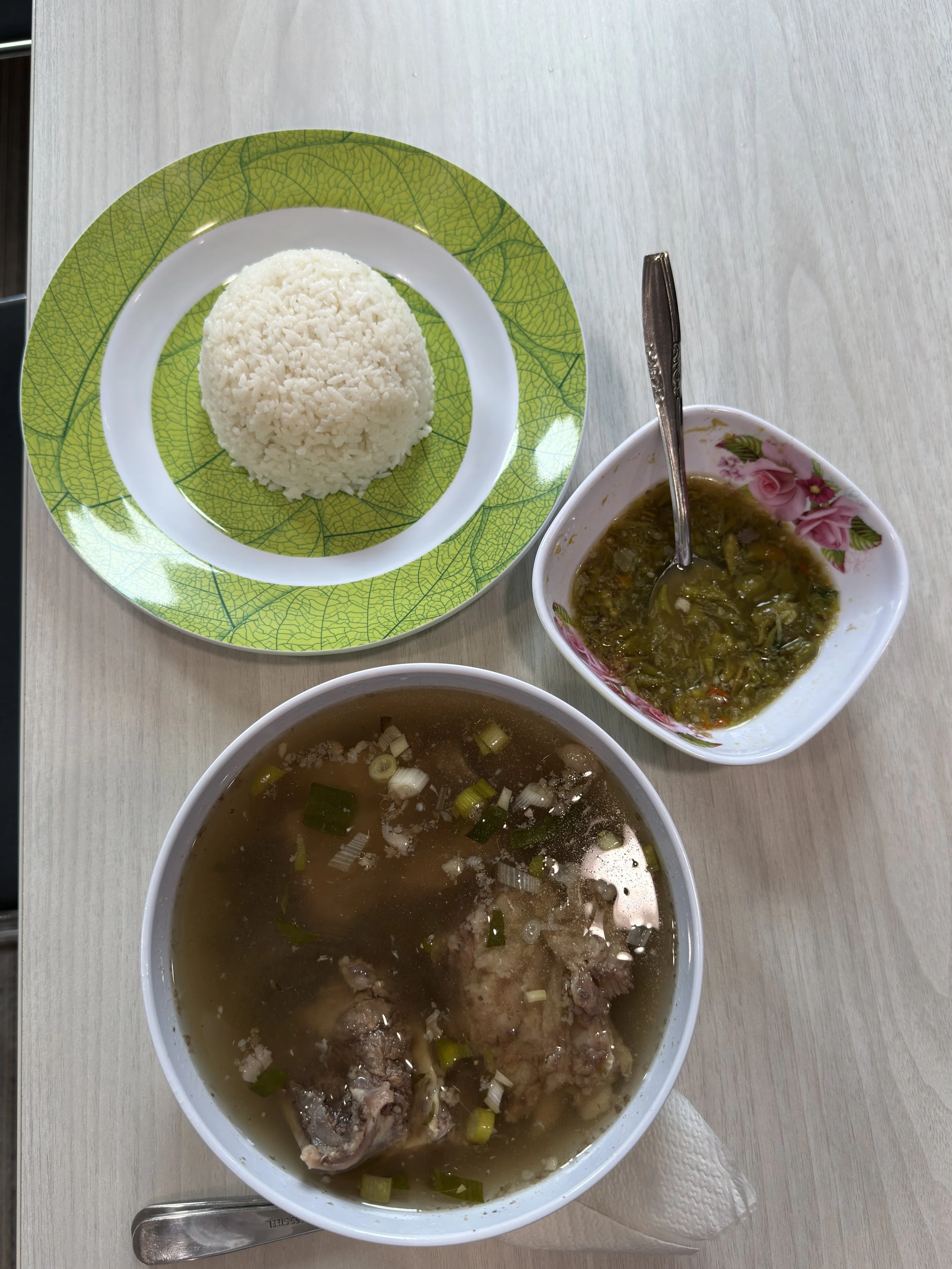
Oxtail soup lunch that also slapped with the utmost spice and force
I learned that portraits of the President and Vice President are on the walls of even corporate meeting rooms, not as (okay maybe not only as) authority reinforcement, but also because Indonesia is made of many ethnic groups and language speakers who came together as a nation after independence, and by putting the portraits on the wall there can be an emphasis on national unity. I learned that many people in Indonesia do not have a family name. Names might be mononyms (a la “Ichiro”), and even a person’s multiple names are often all given names. I heard the 4:?? AM prayer calls (“prayer is better than sleep”).
I got an enriching experience. I needn’t be ashamed. I learned things. I’ll always understand Indonesia much better in the future than I did before. It’s possible that I learned and experienced better by not being obsessed with an unattainable notion of authenticity. The work to be done and realities on the ground put me in a surprisingly pleasant state of acceptance of what the universe might deign to provide. What a privilege to go on a trip there.